ShuleYetu — WhatsApp-First School Management
A multi-school Django platform that brings school-fee enquiries, M-Pesa payments, receipts and announcements into WhatsApp. School teams manage students, parents, enrollments, fee structures and payment records from a role-aware admin dashboard. Parents don't need to install another app.
The problem
Fee enquiries, statements, payment confirmations and school announcements can create a steady stream of manual work. Staff need to identify the right student, confirm what has been paid, allocate money correctly and get the information back to the parent without losing track of conversations or receipts.
The same issue also arises with sending payment receipts, annouceents, fee changes, and other important information. Parents also have to reach out to staff if they want to know whats happening in the school.
In Kenya, WhatsApp is a familiar communication channel and M-Pesa is a familiar way to pay. ShuleYetu connects those everyday tools to a school's underlying student, billing and payment records, reducing the need to move between disconnected manual processes.
What I built
A school inside WhatsApp
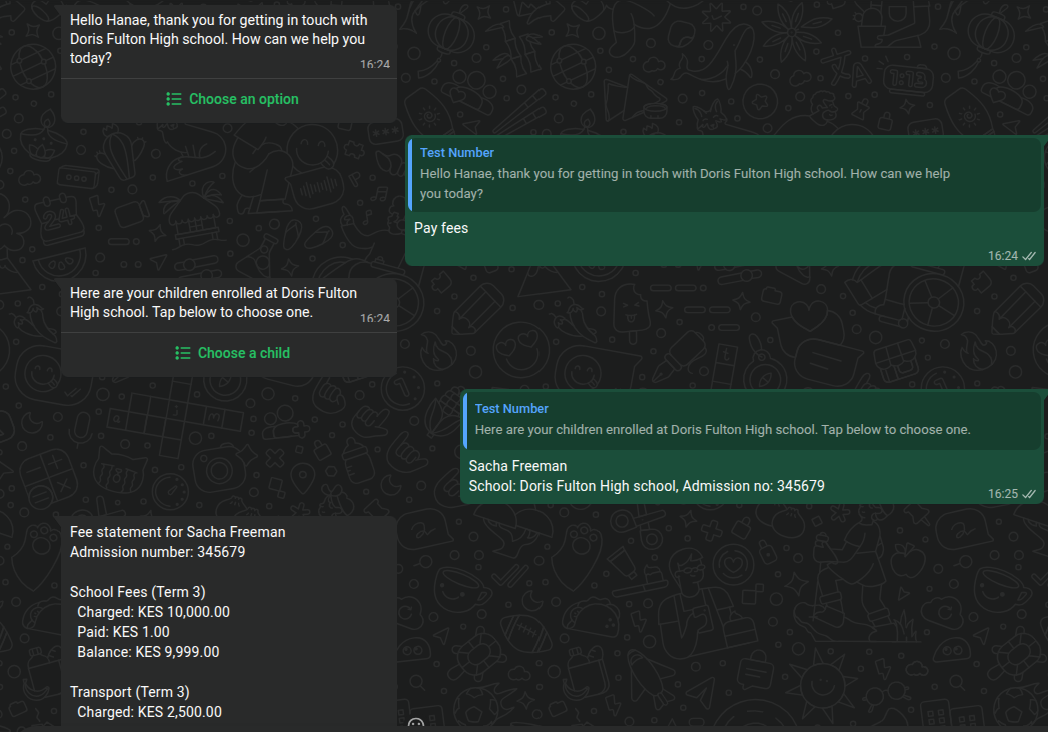
Parents message their school's WhatsApp number and get a simple menu, using list and reply buttons as well as typed options. They can identify themselves, link their children, check a fee balance, request a fee statement, information or school announcement without leaving the chat.
M-Pesa fee payments
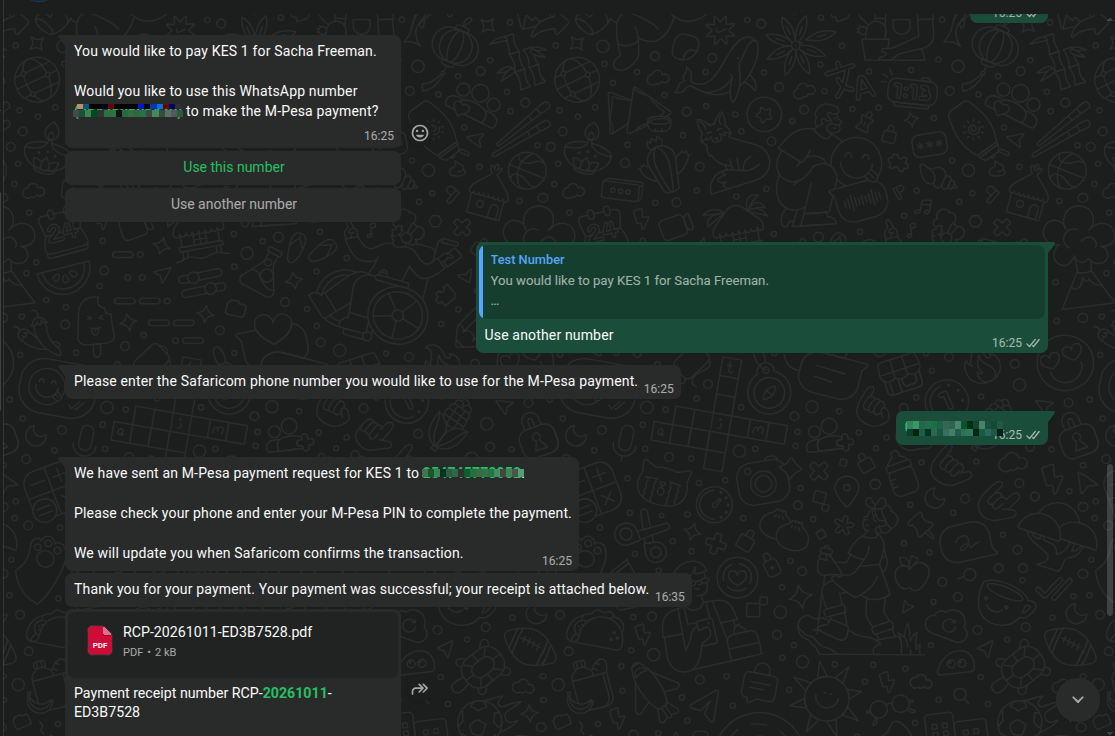
Paying fees triggers an M-Pesa STK push straight to the parent's phone through Safaricom's Daraja API. Once the payment is confirmed, the parent gets a receipt on WhatsApp and the school sees the payment recorded against the right student.
Parents also have the option of paying via M-pesa paybill with debit and credit card payments coming soon. The management system uses the parent's phone number and student's admission number to align and allocate payments.
Multi-school by design
Many schools run on one system. Each school has its own WhatsApp number, so the number a message arrives on identifies the school. Staff accounts are tied to a school through memberships with roles such as admin, finance and staff, so people only see and edit their own school's data. Only a super admin sees across schools.
Student and parent management
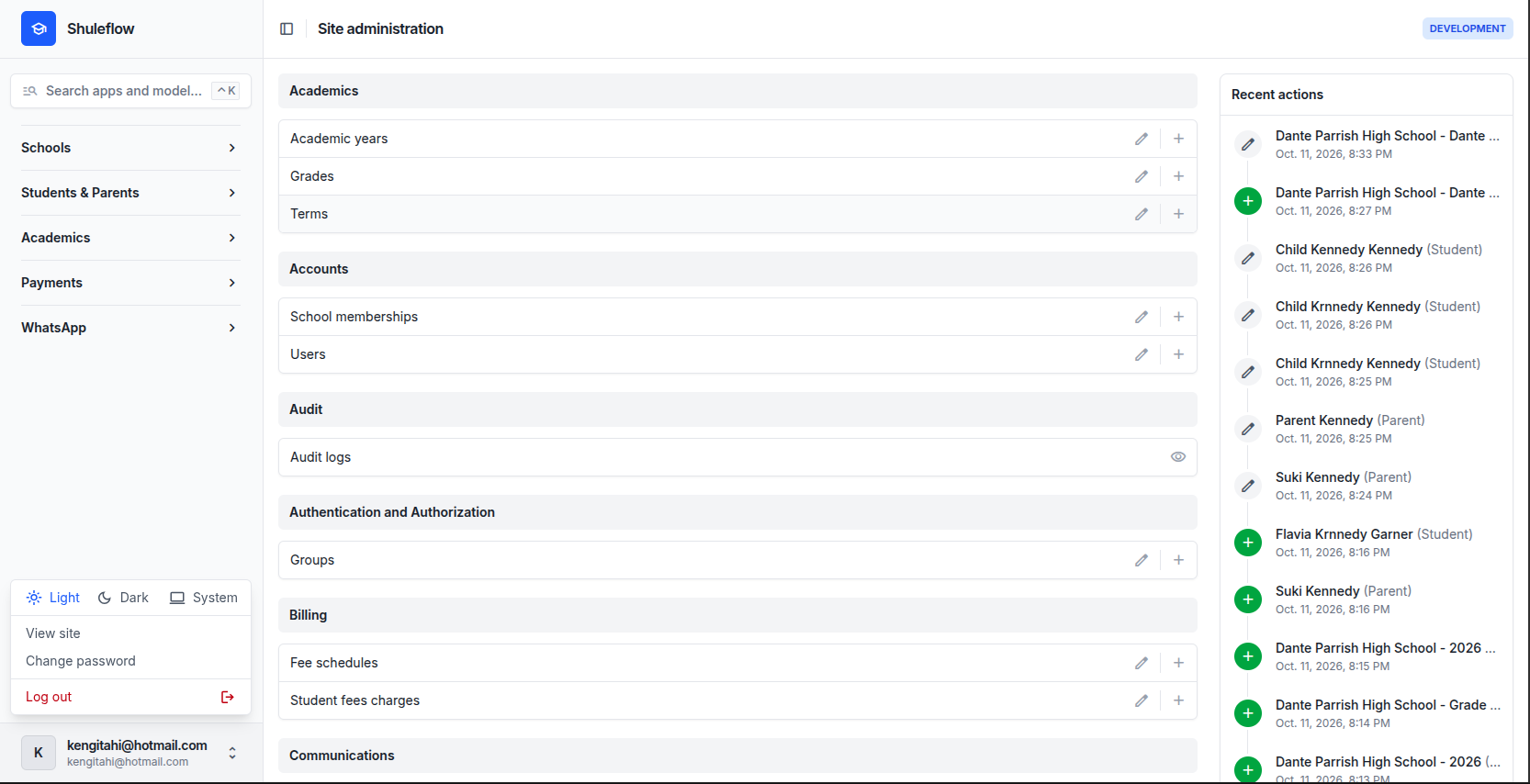
Students, parents, enrollments, grades, terms and academic years are managed in the admin. A parent can be linked to several children, and parents can be selected right from the student form.
Conversations and enquiries
Every conversation and message is recorded. Messages from numbers that aren't registered are stored as prospects for the receiving school, since they are often new parents looking for a place.
Announcements and support
Schools can send announcements to all parents, specific parents, or parent whose children are in a specific grade on WhatsApp, a channel they already read, and parents can ask questions or request help without phoning the office.
School admin dashboard
Built on Django Unfold, giving school staff a modern admin for fees, payment tracking, parent communication and basic reports without a custom back office.
Grade-based fee structures
Fee structures are associated with a grade and academic period. The admin workflow makes the structure visible alongside grade details and enrolled students, while billing services apply charges to eligible enrollments with duplicate-charge prevention as a key invariant.
Payment records and receipts
The payment workflow connects a confirmed M-Pesa transaction to the relevant student account and allocation, then creates a PDF receipt and tracks receipt notification separately from the payment.
Webhook and transaction handling
WhatsApp events and Daraja callbacks are handled as distinct integration paths. Development has covered cancelled STK requests and failed payment states, while idempotency, reconciliation and recovery from interrupted processing remain part of hardening.
How it's built
Why WhatsApp and M-Pesa first
A new app asks parents to install software, remember credentials and learn another interface. WhatsApp provides a familiar entry point, while M-Pesa supports the payment step. ShuleYetu connects these channels to structured school records rather than treating messages and payments as isolated events.
This version of the software is intentionally focused on the operational journey tht includes identify the parent and student, retrieve fee information, initiate payment, process the provider's result, record the payment and issue a receipt. That creates a testable foundation before expanding into a broader school ERP.
Multi-school architecture
ShuleYetu is a Django project organized around school, student, academic, billing, payment, document and WhatsApp responsibilities. A custom email-based user model can be linked to schools through memberships and roles. Admin querysets are scoped to the staff member's school, and school ownership is populated by the application where appropriate. A super administrator can work across school boundaries.
WhatsApp and payments
The bot receives WhatsApp Cloud API webhook events and uses conversation state to track the current step and selected student. It can respond with numbered options, interactive lists and reply buttons. Conversations and individual messages are persisted, and unregistered senders can be retained as prospects instead of disappearing as unmatched inbound traffic.
Fee payments use Safaricom Daraja STK Push to prompt the parent's phone. The callback is the provider's result signal since the application records success or failure and links confirmed payments to the appropriate allocation.
A receipt document and a receipt-notification record are separate concerns, so a WhatsApp delivery problem should not undo a confirmed payment.
Billing and payment lifecycle
The payment path is designed as a sequence of explicit records, with the path including an initiated transaction, a provider callback, a confirmed payment, a student-account allocation, a PDF receipt and a WhatsApp delivery attempt.
This separation makes it possible to investigate where a flow stopped without confusing a successful payment with a failed notification.
The project also includes a shared confirmed-payment service so STK and Paybill/C2B payments can reuse the same allocation and receipt logic.
Admin workflows that reflect school operations
Django Unfold provides the operational interface. Grade pages bring together enrolled students and fee structures.
Student enrollment views show admission numbers in read-only form and fee structures are managed against the relevant grade and term.
Applying a new fee structure is handled through billing services, with duplicate-charge prevention treated as an important invariant.
Where it stands
Parents don't need another app. We bring the school to the parent through WhatsApp, with M-Pesa integrated into the experience.The idea behind ShuleYetu
Need a similar website, platform or tool for your business?
Tell me what you're building and I'll reply with next steps.
Start a project